Inside Popeyes University: How the restaurant chain is building its future leaders


Chief People Officer Matt Hudson explains how a home-grown L&D strategy is turning entry-level jobs into long-term careers and developing the managers needed for Popeyes' next chapter...

When Popeyes opened its first UK restaurant in 2021, the Louisiana-born chicken brand was a newcomer in a crowded quick-service restaurant (QSR) market. Five years later, it has nearly 130 UK restaurants and is opening sites at considerable pace.

Its progress as an employer has also received national recognition. In May, Popeyes UK was named among The Sunday Times Best Places to Work 2026 for the second year running, as well as being highly commended in the list’s ethnic minorities category.

But rapid expansion creates a particular people challenge. Every restaurant needs colleagues who understand the operation, managers who can lead under pressure and senior leaders capable of carrying a young company’s culture into new locations. If that talent cannot be developed quickly enough from within, each opening increases the business’s reliance on external recruitment.
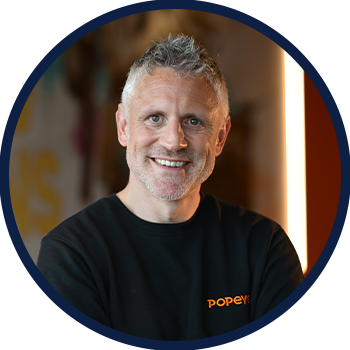
Matt Hudson

Chief People Officer, Popeyes UK

Matt Hudson has watched that challenge grow in real time. He joined Popeyes UK as its first Chief People Officer nearly three years ago, when the business had around 30 restaurants. His remit now spans the entire employee experience, from recruitment, reward and talent management to employee relations, benefits and organisational design.

Hudson previously spent five years at Wagamama and also held roles at Travelodge, having begun his career in the nuclear energy sector.

The opportunity to shape a young, ambitious business was a rare draw.

“In your career, you don’t get a huge amount of opportunities to go somewhere that is so new, that has also got such big ambitions,” he says. “That was the big thing for me. I had the opportunity of growing the business, but it was the brand itself as well. It’s energetic, it’s vibrant. (It’s) something that we really pride ourselves on.”

That growth has now made developing people internally a business necessity. Popeyes University’s task is to give the company the infrastructure to do it.

Creating an L&D playbook from scratch

Popeyes may have operated in the US since 1972 - boasting around 3,000 restaurants in the states - but its UK business could not simply lift a ready-made development model from elsewhere in the global network. As a major franchise operation, the local team needed to define what learning and career progression should look like for its own workforce.

What makes Popeyes a great place to work? I think the leaders. The managers. They’re the ones who help people to thrive, set the tone and the culture

Matt Hudson | Chief People Officer, Popeyes UK

Hudson explains, “With us being a massive franchise, we didn’t have a learning & development playbook to use, so we created our own completely from scratch.”

Developed over several years, Popeyes University houses the company’s operational training, leadership development, career pathways, apprenticeships and wider learning. It covers practical restaurant skills alongside areas including diversity, equity and inclusion and neurodiversity.

The commercial case is straightforward - Popeyes is opening dozens of restaurants every year in the UK. A new site must initially be staffed from outside the company because it has no existing team or succession plan within that location. Hudson wants that balance to shift as the organisation matures.

“When you’re opening 50 restaurants a year, you’ve got to make sure you’ve got your talent acquisition processes in tip-top order as well, because when we’re opening new restaurants, we have no succession plan - it’s all external talent coming in,” he says. “The university was the idea of what a good career development offering would look like.”

Popeyes has also run its employee engagement survey, The Big Listen, twice now, with development emerging as a clear priority both times. Employees wanted greater access to growth opportunities, giving the people team a powerful internal case for investment.

Popeyes University is also designed to recognise the reality of the QSR workforce. Some employees arrive looking for a career, while others regard restaurant work as a part-time job, a side hustle or something to do alongside their studies. But Hudson does not believe development should be reserved only for those planning to stay indefinitely.

“The future goal is life skills,” he says. “We recognise that a lot of people work for us. They might work in QSR because it’s a side hustle or it’s a job to do while they’re studying. If they do leave us, we help by giving them interview skills, explain how they can get a mortgage, how to save money etc. So that’s a future direction we want to go down. You can learn how to do the job and have a great career with us, but if you do want to go somewhere else, we’ve given you something back.”

Climbing the Louisiana Ladder

At the centre of the university is the Louisiana Ladder, Popeyes’ structured route through restaurant operations. Joy Creators, the company’s name for general team members, can progress into shift management, then assistant general management, general management and, eventually, operations management.

Hudson says the distinctive job title is rooted in the experience Popeyes wants its teams to create. “We want them to be happy, and we want them to spread joy into the teams and customers. That’s part of our culture, DNA and heritage.”

Around 80% of development at each level of the ladder takes place through online and on-the-job learning. That is supplemented by face-to-face leadership development, with the amount increasing as employees move into more senior roles. A team member preparing to become a shift manager receives one day of in-person training, while an assistant manager moving towards a general manager role receives four.

The content moves beyond the mechanics of running a restaurant. “Its about ‘how do you lead a shift? How do you lead people performance? How do you help people who are struggling? How do you spot people who are neurodivergent?’” Hudson says.

He describes neurodiversity as a particularly important part of the programme and estimates that around one in two people working within QSR may be neurodivergent. For Popeyes, that creates a duty of care to help managers recognise where colleagues or customers may need support.

The company also uses a learning management system for compliance content and wellbeing seminars, as well as Microsoft Teams where appropriate. Yet delivering L&D across a workforce with many transient and part-time employees demands flexibility. Some subjects are kept in person because Hudson believes the quality of discussion matters more than convenience.

“With the subjects that we feel very passionate about, that we want to really educate people on, such as inclusion, that's all done face-to-face,” he says. “We utilise Teams but sometimes you can’t beat being in the room and having those conversations.”

Continue reading for FREE!

Sign up for a myGrapevine account to get:

  • Unlimited access to News content
  • The latest Features, Columns & Opinions
  • A full range of specialist HR newsletters to choose from

Welcome Back

Sign up for myGrapevine

* By creating an account you agree that you have read and agree to our Terms and Conditions and that Executive Grapevine International Ltd and its partners may contact you regarding relevant content and products. You will also be added to the HR Grapevine newsletter mailing list.