 USA
USA  United Kingdom

We’ve all been there. The dreaded mandatory training session made all the more soul-sapping by monotonous material delivery, stuffy meeting rooms, and creaky office chairs prodding and probing spinal cords with every passing second.
Surely corporate learning & development doesn’t have to be this way!
Well, at Google, it isn’t. Since 2019, the tech giant has been exploring how physical space and sensory stimulation can shape the success of learning programs.
Maya Razon has been part of the company’s neuroaesthetics work since its early days. As Product Lead for Leadership Development at The Google School for Leaders, she plays a key role at the center of excellence where Google’s managers and leaders receive training on managing the dynamic and rapidly changing demands of their roles.
Razon tells HR Grapevine that by better understanding the impact of the sensory environment on learning outcomes, Google has honed a “limitless” ability to better engage its employees in their skills development and training programs.
What is neuroaesthetics? And how did Google discover the concept?
“Our sensory environment profoundly affects how we learn, feel, and connect,” Razon begins, in an exclusive interview with HR Grapevine about how The Google School for Leaders has embraced the concept of neuroaesthetics.
“It is an emergent multidisciplinary field focused on understanding how the brain perceives and processes aesthetic experiences,” she says, offering a beginner’s definition. “By using brain imaging and mapping, it seeks to understand the physiological impact of sensory experiences on our brain and behavior. The discoveries from neuroaesthetics have clear implications for how we design learning spaces and experiences.”
In other words, Google’s leadership development team believes that where and how individuals learn is almost as important as what they are taught.
This concept first inspired Razon before her tenure at Google, in a corporate role at Gap Inc., where she worked with a colleague to set up a creative space for the clothing retailer’s learning team.
Our sensory environment profoundly affects how we learn, feel, and connect
Since that project, she has come to see physical space as a “co-facilitator of an experience and a lever that can be used to significantly impact learning experiences,” from small groups to rooms of hundreds of employees.
At Google itself, the idea took shape during the 2019 Salone del Mobile, Milan's annual international design fair.
The company’s hardware design group hosted an exhibition, dubbed ‘A Space for Being’, in collaboration with a number of designers and neuroaesthetic researchers.
“The exhibition featured three distinct rooms, each with unique visual aesthetics, ambient sounds, scents, textures, and colors,” Razon explains. “As attendees moved through these spaces, a specially developed wristband measured their physiological responses, tracking indicators such as heart activity, breathing rate, skin temperature, and motion.”
The findings from the exhibition, rooted in the principles of neuroaesthetics, subsequently informed how The Google School for Leaders designed The Schoolhouse – Google’s bespoke physical learning space at its Mountain View campus – in partnership with Rapt Studio and the International Arts + Mind Lab.
Touch, taste, & smell: How Google applies neuroaesthetics to learning & development
Razon's biggest sources of inspiration during the creation of The Schoolhouse were immersive theatre and, naturally, the 4D movie at Legoland.
“In both examples, the audience is propelled into the experience and called upon to be an active, engaged participant,” she says. “If we can do that with learning – ignite and engage participants – I think our ability to inspire learners and affect change will be profound!”
Accordingly, neuroaesthetics have been integrated into The Schoolhouse through stimulation for each of the senses.
To start, touch. “We placed items throughout The Schoolhouse, such as curated furniture and over 100 artifacts selected for their form, function, and sensory qualities to invite interaction,” Razon explains. “The interactions can be impromptu or integrated into learning experiences to make the curriculum come to life via 3D objects, enhancing the learning through tactile activities.”
And for smell – known to have a strong impact on memory – Google installed Willy Wonka-esque ‘scratch and sniff’ wallpaper in the entryway to its learning facility. There are containers of frankincense in the breakout rooms too, so participants can grab a few pieces if they wish to incorporate scent into their learning experience.
That element of choice is an important one, she notes: “I learned from Mandy Aftel that giving people the element of choice with scent is critical, as people’s relationship to scent is very individual and personal.”
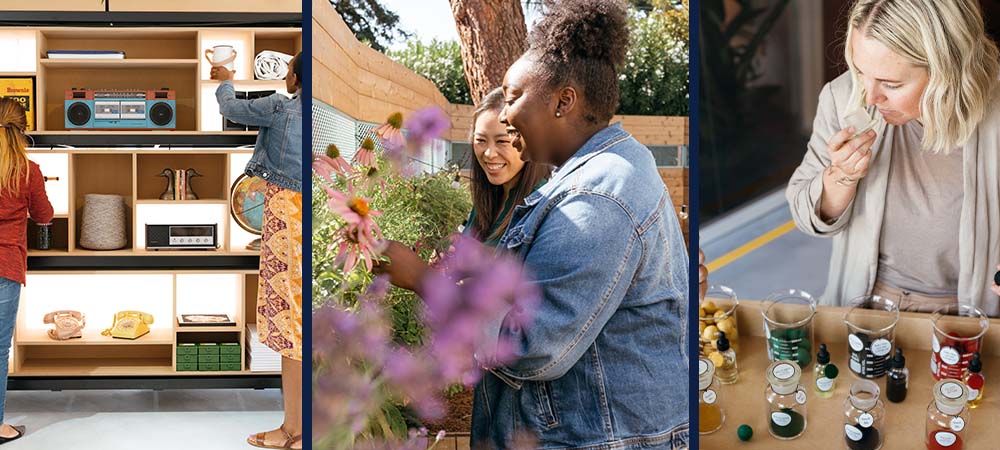
A wall of edible plants in the Schoolhouse’s courtyard is also available for Google’s leaders to stimulate their brains' pleasure, memory, and emotion centers. Participants can use the plants to make tea, a feature, Razon says that “invokes unexpected wonder.”
And to avoid any chance of drab décor leading to disengagement from the learning program, Google uses light and natural elements strategically. These allow Google to customize the learning experience for participants by adjusting light intensity and color, providing access to natural light and an outdoor patio, and integrating biophilic design (e.g., plants) into the space.
“Our approach is validated by external research,” Razon notes. “The benefits of natural lighting on student achievement are well-documented, as are the positive impacts of nature-like surroundings on mood and cognitive function. Regular access to nature improves our health, happiness, and cognitive performance.”
A sound idea! Why Google uses playlists to engage learners
Razon draws particular attention to playlists Google has created – “one of my favorite tools to enhance the learning experience,” she says – and how they are employed at different stages of the learner experience, including arrival, breaks and transitions, and moments of reflection.
“Sound helps learners fully engage in their learning experience,” she explains. “They [playlists] are simple to integrate yet incredibly impactful. Each playlist is crafted with an understanding of music’s effect on cognitive and emotional states and is designed to support different aspects of a learning experience.”
For example, upon arrival at The Schoolhouse, Googlers are greeted by the ‘Morning & Arrival’ playlist with energizing tracks like Tekno’s Enjoy, to “spark a positive tone and help people ease into initial conversations.”
Learning at The Schoolhouse was often described as a departure from the everyday workplace environment, research shows that that kind of shift in mindset is more conducive to learning
Later in the day, during a reflective exercise, attendees might expect to hear Bremer/McCoy’s Forenet, to “set the tone for inward focus.”
Other moments call for “soundscapes” drawing from Brazilian samba, Indian electronic, cinematic ambient, or classical piano.
Whatever the song, Razon says the goal is always the same: “To create an environment that supports deep connection, creativity, and learning.”
Google's award-winning, mindset-shifting L&D
Razon proudly notes that Google’s work to embed neuroaesthetics in the design of physical learning spaces has received internal and external plaudits alike.
The Schoolhouse itself received multiple design honors, becoming the 2020 FX Workplace Environment Small Winner, the 2020 WIN Awards Learning Interiors Winner, and the 2021 Inside World Festival of Interiors Awards Education Winner.
The trial also proved the use case for a wider rollout at Google beyond the leadership development group, with The Schoolhouse becoming a “model and inspiration for a range of new learning spaces” at the company.
For other employers considering the application of neuroaesthetics and sensory stimulation, Razon has some parting advice: “Designing for adaptability and flexibility is key.”
“Having the ability to change the size and shape of the learning space with movable curtains and spinning furniture, resetting the space with adaptive furniture configurations, flexible seating, and adjustable lighting ensures we can customize a huge variety of learning experiences using the same space, even making changes to the environment within the same day,” she explains.
But perhaps most importantly of all, Razon says that embracing neuroaesthetics has transformed the learning & development experience for program participants.
“The participant experience was telling,” she concludes. “Learning at The Schoolhouse was often described as a departure from the everyday workplace environment, research shows that that kind of shift in mindset is more conducive to learning.”
A Space for Being was co-created by Google's Chief Design Officer for consumer devices, Ivy Ross, in collaboration with Muuto’s Design Director, Christian Grosen; Reddymade Architecture and Design Studio Founder and Principal, Suchi Reddy; Executive Director of the International Arts + Mind Lab at Johns Hopkins University, Susan Magsamen; and founder and perfumer at Aftelier Perfumes, Mandy Aftel.
Learn more about how Google is using science to enhance learning outcomes.


