UK
UK  United States
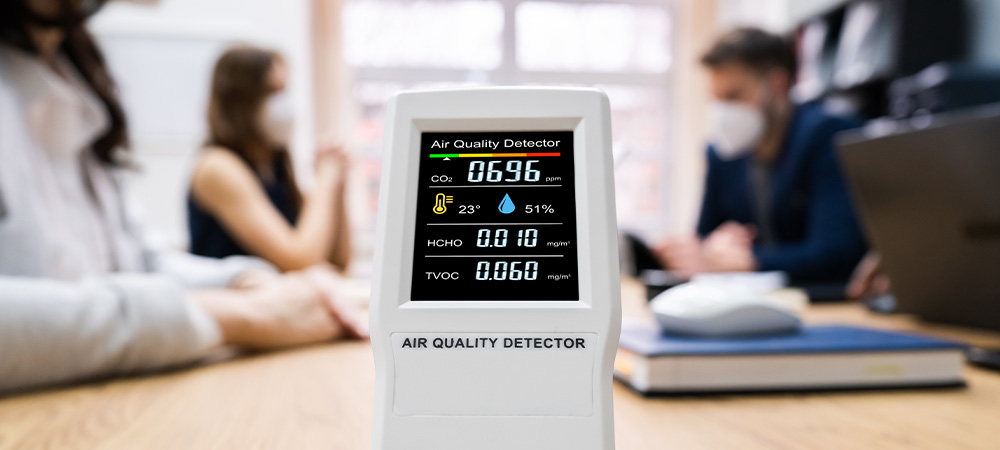
There's a number in the room your employees are sitting in that predicts how well they can think for the next hour. It isn't the temperature, it’s the carbon dioxide, and if the window's been shut all morning, it's costing your business.
Small tweaks to your immediate environment can bring big gains in focus and clarity
Most people think about their workspace in terms of ergonomics - a good chair, a decent desk - and stop there. But published research, and plenty of anecdotal evidence, points to something broader: the air, light and sound in our immediate environment can meaningfully shape how well we think. Dr John Briffa is a medical doctor with more than 30 years of clinical and corporate experience, and author of The Performance Prescription: The Science of Sustainable Success. HR Grapevine spoke to him about the science-backed tweaks that can transform focus, clarity and output at work.
My advice is to keep CO₂ levels below 700 ppm. What helps here is having at least two points through which air can flow, such as a window and a door left ajar, ideally on opposite sides of the room
Air quality is quietly sabotaging cognitive performance
"One critical factor is the air we breathe - specifically, carbon dioxide levels," Dr Briffa says. Outdoor air sits at around 400 parts per million (ppm) of CO₂, he explains, while a reasonably well-ventilated indoor space runs between 500 and 1,000 ppm. Poor ventilation can push that significantly higher and that, he says, risks choking our cognitive functioning.

Dr John Briffa
Author of The Performance Prescription: The Science of Sustainable Success
He points to a study in which office workers were exposed, unbeknownst to them, to three different CO₂ concentrations on different days. Compared to the lowest concentration of 500 ppm, exposure at 945 ppm reduced overall cognitive function by 15%. At 1,400 ppm, performance fell by half.
"My advice is to keep CO₂ levels below 700 ppm," he says. "What helps here is having at least two points through which air can flow - a window and a door left ajar, ideally on opposite sides of the room." Tracking levels is straightforward too, he adds, from simple standalone monitors to more sophisticated devices. One that he suggests is Netatmo's Smart Indoor Air Quality Monitor, which he says delivers real-time data on CO₂, temperature, humidity and noise via a smartphone app.
Volatile organic compounds, or VOCs - commonly emitted by desks, chairs, soft furnishings and carpets, particularly new ones are worth watching too he notes. "The same study found that VOCs also impair cognitive function," Dr Briffa says. Good ventilation helps reduce exposure, and he suggests keeping houseplants in the room, since soil has been shown to absorb VOCs from the air.
The combined effect, he says, is substantial: moving from a high-CO₂, high-VOC environment to a low-exposure one doubled cognitive performance in the study.