USA
USA  United Kingdom
For HR chiefs across the world, the defining question of their career will be this: What does it mean to build an organization where people and AI actually amplify each other?
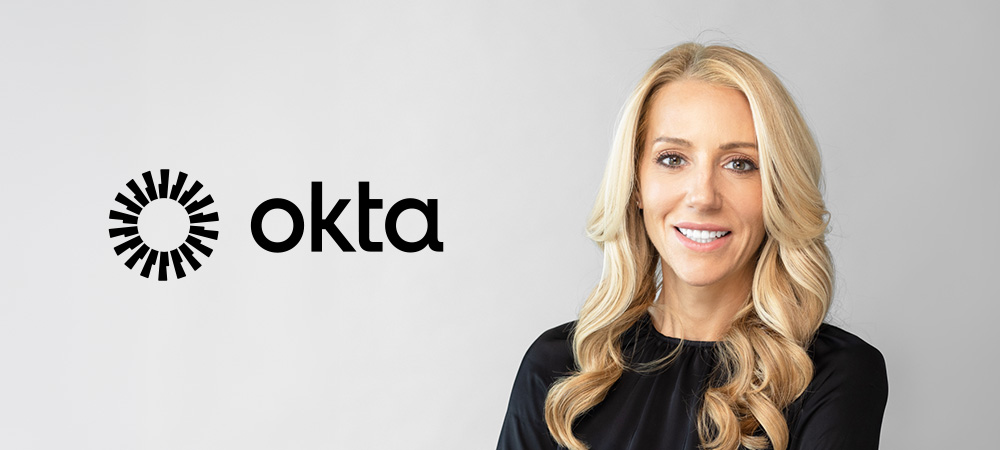
At Okta, Chief People Officer Rebecca Port is confident that the answer reaches far beyond minor Claude-enabled productivity gains, or ChatGPT-drafted reports – that there is a new wave coming where roles will be descontructed and rebuilt.
Speaking to HR Grapevine, Port sets out why Okta’s talent, AI, and business strategies are now firmly interlinked, and reveals how the SaaS giant is ripping up its org chart to make work more productive and enjoyable.
You’ve said culture strategy is now business strategy – what does this mean at Okta?
Culture is how you execute your business strategy. I believe that without the right culture, you can't execute your vision, achieve all the things that you want to achieve, or win the prize, whatever that prize is for your business.
The next era of development is really about helping leaders and managers deconstruct roles, and empowering the best leaders to really look at their organisation differently
At Okta, we've really been focusing on identifying the right culture to take us through as we move into securing AI. Some of the things that we've done in the past may not be appropriate us as we go into the future. We're really looking at; how can we simplify? How can we move fast? How can we thrive in change? How can we raise our own bar?
As an HR leader, how have you ensured your talent strategy aligns with Okta’s business & AI priorities?
We start with the business strategy. We start with what the priorities are, what the goals are, where do we want to go, and then work backwards from that.
What do we need to do? What's the talent that we need to execute that strategy? And that then becomes the people team strategy. We’ve said we need to go through a cultural transformation to make sure that we've got the right environment to execute in an era of change, and an AI era.
For example, one of our priorities within the people function is to catalyse and crystallize what we're calling our 'door 2 culture.'
What does it mean to be an AI-first business from a talent perspective?
We are definitely an AI-first company – as we look to bring people into the company, we're looking for a certain level of AI proficiency.
With our existing employees, we're offering all kinds of development so that people can keep up to speed with what is changing, and quickly. If I look back 12 months, the training was around prompt engineering. Now it's around vibe coding. We recently had an AI day in the people team where the entire day is dedicated to creating agents, apps, or tools that are useful to you in your everyday job.
We've really taken on this philosophy of 'go out and experiment.'
How have you rebuilt roles at Okta to ensure humans can focus on what they do best?
This, for us, is the next wave.
Organizations have been using AI for modest productivity gains. Things like Claude Code to help me do PowerPoint; ChatGPT help me write better reports. Over time, some of those things that we're seeing people experiment with will become product features in Google Slides or Gmail, for example.
The next era of development is really about helping leaders and managers deconstruct roles, and empowering the best leaders to really look at their organisation differently.
At Okta, we fully believe there will be agents on the org chart. And that's not every single small agent that somebody is experimenting with. But when you look across a series of jobs, you deconstruct them, and say this set of tasks can actually now be done by an agent, which means these other three roles are therefore different.
Do you have an example you can share?
We're looking at how we can support managers in the HR team, and have looked across our HR business partner roles, our employee relations roles, our people operations roles, and said, what are all the ways in which HR interacts with a manager?
What are all the types of requests and help that managers need? And which of those can we cluster together and say this could be done by an agent?
HR will be a facilitator of this process, but really it will be led by leaders throughout the organization
And if that work was done by an agent – for example, a performance management conversation where an agent writes up the manager some notes and sets up an appointment with the individual – then what are the implications for that on an HRBP [human resources business partner] role or an ER [employee relations] role?
We’re looking at each of our workflows and being clear on what the roles and responsibilities are, and where the handoffs are, and when does something transfer from an agent or a digital worker back to a human worker.
That sounds challenging – but Okta’s view is this is the future of HR?
It takes a long time, and I'm not seeing a huge amount of this in the market. I think there's lots of talk about doing this, but that process end to end can take six to 12 months because you have to think about the roles, you have to deconstruct the roles, you have to find the agent. And then answer, is that a build or is it a buy? Do you have existing technology? Then you have to pilot it. Then you have to manage through all of the change.
But as we go through into the future, I expect every function in Okta to be doing this and for leaders to be constantly thinking, how can I deconstruct roles? There's some roles where the people team are heavily involved, some where managers and leaders are at the forefront and leading this for their own functions.
HR will be a facilitator of this process, but really it will be led by leaders throughout the organization.
How might this impact the role of managers and leaders?
This will be an evolution over time. A skill that we will see more of will be vigilance.
If you think about a manager's role, managers do a lot of approving and more administrative tasks. That will go away, but there will still be a need to be vigilant, to check and audit what agents are producing or what digital workers are producing.
What measures might you look at in terms of a successful approach here?
We’ll measure if job satisfaction goes up – I expect that in the near term, there’ll be a dip as we go through changes, because change is difficult for many people for a whole series of reasons.
But as we get through this transition, I expect that people will get much more satisfaction from the work that they can and that AI can't do, like judgment, creativity, innovation, understanding context, and having human conversations. Work will become more enjoyable.
What changes have you made to your talent processes to ensure Okta hires the right people?
One of our cultural principles is thrive in change. And we are really looking for those people who can be resilient in change, who can be adaptable, and who are really curious. Curiosity and adaptability are going to be absolutely critical as we go through this huge technological leap, which means that the world is going to be very different five or 10 years from now.
We interview for that. We look for people who have thrived in different environments. We look for people who have been resilient during other periods of change. We’re assessing whether these candidates are people who can think through, ‘How do I simplify something?’ ‘How do I move fast?’ ‘How do I raise my own bar?’
There's an element of ambition as well that we're looking for.
What have you learned about your approach so far that you'd share with other CHROs?
The companies that will win in an AI era will not necessarily be the companies that have the best AI technology. They will have the leaders who are best at deconstructing roles, rethinking workflows, leveraging AI technology to work differently, not just to replace existing workflows, processes, or roles.
There's an opportunity to reinvent and disrupt, so [we’re] trying not to look at things in the way that we've always looked at things. For HR professionals, this means taking on a design and systems thinking perspective is important.
The companies that will win in an AI era will not necessarily be the companies that have the best AI technology. They will have the leaders who are best at deconstructing roles
Everything that we do, I try to think of as a product. Who is the end user? How does this feel? What other products does this interface with? And how can you look at workflows differently rather than within the silos?
How will Okta's HR team lead on AI adoption moving forward?
Even within the HR function, I find that often we operate within our particular groups – learning and development, compensation, HR business partners, and so on. So, we’re trying to look across functions.
Doing this work in our own function is a really good practice site. You can kind of figure out how to do this work, what models and processes help to do this in your organization.
As we've looked to implement AI, there are two decision factors we consider when asking if we should be leveraging AI here. One is experience, and the other is expense. Does this enhance the employee experience? And is it actually more cost efficient to do it this way or is this really expensive? Even it's really expensive and it adds cost into the system, the experience it gives might make it worthwhile.
Both of those lenses I find really useful to look at, because just because something can be done by AI doesn't necessarily always mean it should be.