USA
USA  United Kingdom


Several years ago, a team at Google began a project to build a new suite of learning programs and strategies designed to help its managers become better at leading teams.
There was just one problem. To build relevant learning, they needed substantive data about how managers truly felt about their role and responsibilities in leading teams.
Detailed manager feedback was missing, and without this critical input, developing products that centered on user needs and experiences was near impossible.
To solve for this problem, Google created a new cross-functional, research-backed approach to collecting user data: The Google Learning Advisors Program.
The creation and impact of this manager advisory program has not been made public – until now. HR Grapevine can exclusively reveal not only the existence of the Google Learning Advisors team, but also its impact:
Deeper insights into the stories, perspectives, and feelings about life as a manager at Google, both on longer-term asks and rapid, urgent questions
Invaluable understanding of the challenges facing Google managers, as well as their attitudes, needs, and concerns
Products, processes, and strategies designed for managers and their needs, leading to more effective leaders who inspire more productive, satisfied, and engaged teams
We spoke to The Google School for Leaders – a department that develops unique learning experiences based on research-backed applications of creativity, neuroscience, and academic expertise – alongside Design Researchers Becca Anzalone and Caleb Gatlin on Google’s People Development team, to lift the lid on the creation of the Learning Advisors Program and how other employers can replicate its success.
What is the Learning Advisors Program?
As a wise product manager (probably) once said: Good luck creating a product without understanding the customer first.
So, to uncover qualitative research-backed perspectives and enable rapid manager feedback that could inform nuanced product development, the People Development team established the Learning Advisors Program.
An article produced by The Google School for Leaders for Google’s re:Work site and shared with HR Grapevine outlines the initiative: “Google’s Learning Advisors program brings together a representative group of Google managers who regularly share their experiences and feedback to inform Learning & Development products, programs, and strategies.”
Every few weeks, the volunteers participate in short, creative activities designed to elicit stories, perspectives, and feelings about life as a manager at Google. The research team then distills the “rich array of input” into “thoughtful, nuanced insights.”
Members of the manager advisory team also offer quick answers to urgent questions from the research team, leading to rapid testing, feedback, and iteration loops for manager-centric L&D products.
This feedback bolsters other data that comes from internal quantitative surveys conducted by Google – such as company-wide studies about the behaviours of effective leaders – leading to a blend of research that gets to the heart of managers’ lived experiences.
“The Google Learning Advisors program helps The Google School for Leaders understand managers in a more human way, so they can design for them and their needs through products, processes, and strategies,” the article explains. “Advisory groups like this enhance our understanding of the manager experience.”
Anzalone and Gatlin add: “Quantitative data is amazing at telling you what is happening, but without qualitative data, you can sometimes miss (or misdiagnose) the why and how. That’s what our learning teams were struggling with.”
Why Learning Advisors is ‘vital’ for Google’s organizational success
The logic is straightforward. Deeper managerial insights mean better L&D products. Better L&D products mean more capable managers and leaders. More capable managers mean improved performance.
In fact, Google goes as far as to describe the perspective of managers as “vital for organizational success.” Effective managers, the article says, “lead more productive, satisfied, and engaged teams.”
Anzalone and Gatlin emphasize that the success of the Learning Advisors program is made clear through the strategic impact it has had on learning product development and the value it provides to the Advisors themselves.
“Our design teams now embed these rapid feedback loops into their development cycle from the start. We liken each feedback loop to ‘pointing the compass’ as we build, ensuring we’re on the right track every step of the way,” they explain. “This helps make sure we’re building solutions for the real, nuanced challenges managers face, not just the ones we assume they have. This shift from designing in a vacuum to co-creating with users is our most important metric of success.”
Over the years, the Learning Advisors program has revealed significant challenges and opportunities experienced by Google managers, as well as their attitudes, needs, and concerns.
For example, managers said they want to be addressed in a way that conveys trust and partnership. They wanted to feel “seen.” In turn, this insight influenced everything from the names of L&D programs to the language used in manager-specific communications.
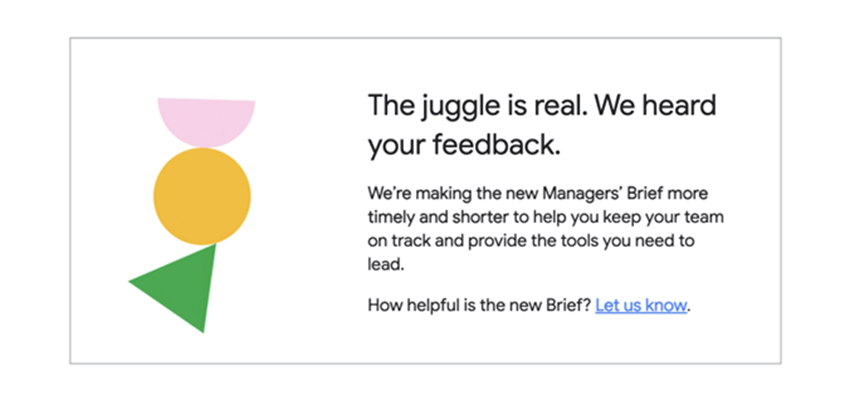
Graphic developed for internal manager communications, informed by insights gleaned from The Google Learning Advisors program.
Learning Advisors research also showed that Google managers wanted help tackling “ambiguous” scenarios.
“Often in learning experiences, when you encounter an example situation, it’s way too clean,” Anzalone and Gatlin explain.
“There’s a clear right answer or path, which is there for the very valid reason that it makes the lesson you’re supposed to be learning clear and easy to understand. But real life never feels like that.
“We heard over and over again from managers that they wanted more sample scenarios that show the messy “gray” of real life.”
According to the The Google School for Leaders article, the team has since started testing “practice scenarios for manager development programs with Google Learning Advisors to help ensure we’re reflecting the challenging nuances managers are likely to face.”
Encouraging ‘courageous’ managers
Another valuable takeaway from Google Learning Advisors was a new layer of insight into earlier research about wider frustrations with manager feedback. Quantitative sources showed that employees felt like they weren’t getting enough performance feedback from their managers, while Google leaders didn’t think their teams were getting enough feedback in general.
“One hypothesis the team had was that managers needed a push to be more “courageous” about giving feedback.”
After asking managers what it was like to give performance feedback, the team learned that there are “fundamental orientations that managers have to giving feedback” that powerfully influence how they approach the process.
“For example, some managers believe their most important responsibility is to keep their teams motivated and appreciated,” the researchers continue. “Other managers believe their most important responsibility is to deliver on their work expectations in a timely, effective way. Of course, both are critical, which most managers also understand – but when push comes to shove, the first group of managers will optimize for the person’s experience and the second will optimize for the work’s delivery.”
This ensured that rather than rolling out a generic 'courageous conversations' workshop - “a product that would have failed” - the team instead built a diagnostic tool that empowers managers to pinpoint the core beliefs driving their style, revealing not only what they’re already doing well, but also the specific blind spots that might be getting in their way.
“By understanding the 'why' behind their approaches, we could design a more nuanced product with different tools and frameworks tailored to each of these very different managerial mindsets,” Anzalone and Gatlin note.
Improving career conversations
At an individual level, the program has also helped Google shape the personal development and career growth of its managers.
“People aren’t great at knowing what they’re bad at. Or, said a little more precisely, people are more likely to attribute challenges that they have because of skill gaps to their external environment,” Anzalone and Gatlin explain. “This finding unlocked a huge opportunity. We could not only help people solve their immediate challenges, but also empower them to see the connection between the problems they were facing and their own opportunities for growth.”
The team also learned that many Googlers (including managers) struggle with long-term career planning and the self-knowledge needed to articulate their goals, often focusing on short-term achievements like promotions – compounded by the fact that career considerations are “deeply personal, touching on sensitive topics like family, finances, identity, and self-worth, which require vulnerability and a safe environment to discuss.”
“We learned that the ability to reflect on your career is a skill that has to be built intentionally,” the researchers add.
The finding pushed Google to increase its support for both employees in developing self-awareness and managers in creating space for vulnerable conversations dedicated to career planning.
Google’s tips for building your own manager advisory program
August 2025 marks the first time Google has publicly shared the existence of this program and its successful impact on L&D.
To mark the occasion, The Google School for Leaders has developed a set of guiding principles for companies eager to successfully build their manager advisory program – noting that the specifics of a manager advisory program will vary depending on the needs of each organization.
“We've been gathering data and refining our approach for several years to ensure we had a truly impactful solution,” Anzalone and Gatlin tell HR Grapevine. “The recent launch of our manager training, which received a 91% CSAT from 30,000 managers globally, is a testament to that work. We're now making our findings public through Google re:Work because we believe this is a proven best practice that can benefit organizations far beyond Google.”
Google gave HR Grapevine permission to publish its manager advisory guiding principles in full:
1. Be intentional about your participants
While your advisory group might not perfectly represent the entire organization, try to actively seek out members with a wide range of backgrounds, roles, and experiences to mirror your larger population as closely as possible. You should also seek input from cohorts that you rarely hear from, or that are not necessarily your biggest supporters.
At Google, we reboot the program periodically, bringing in new, energetic voices. Our first Learning Advisors cohort had around 60 participants; now, in our fifth iteration, we have about 130 participants.
2. Be clear about “the contract” from the start
Managers are busy. To gain the trust of your advisory group and promote strong engagement and participation, it’s important to be clear about the monthly time commitment, the length of the program, and what their feedback can and cannot influence. In our program, interested managers complete an application process where they learn about and agree to the participation expectations from the start.
We also make it clear what’s in it for them. In our call for volunteers, we present The Google Learning Advisors Program as a chance to join a global network of people passionate about the culture of learning at Google and as an opportunity to influence programs that will touch managers across the company.
3. Keep them engaged
To maintain the rhythm and drive of the group, reach out on a regular, frequent cadence – every two weeks or at least once a month. And keep the group members interested by changing up the format of the activities. Some of the creative activities we’ve used include:
Having managers select images to represent their feelings or reactions.
Hosting focus group discussions to surface feedback on early stage programs still in development.
Asking group members to fill out a Mad Lib-style “Postcard from your future self.”
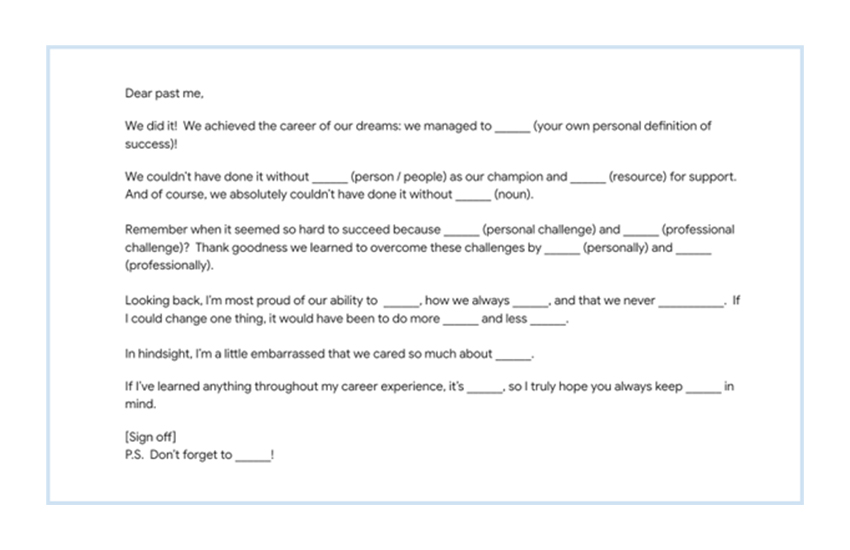
Example of a creative, Mad Lib-style activity completed by learning advisors.
4. Focus on them, not their peers
When you ask questions of your advisory group, place the focus squarely on them. You’re looking for genuine reflections about their personal, lived experience, not what they think others might be feeling or what conventional wisdom might say. Personalize your questions and creative activities as much as possible. For example, instead of asking a generic question like, “What would make X most impactful to managers?” rephrase it to say, “If you were in charge of X, what would you do?”
5. Go in ready to learn
Qualitative research of this nature is intended to be exploratory. Don’t go into it trying to prove a point or validate a hypothesis, but instead to learn more about your audience. Expect to come away with new ideas and directional insights, not assertions like “70% of Advisors said X” (the smaller n-count means percentages are rarely statistically significant anyway).
6. Co-create with feedback loops
Treat your advisory group as an ongoing collaboration. Once you make changes and iterate based on their feedback, go back to the group to ask if you are moving in the right direction. These feedback loops act like a compass, allowing you to draft, test, iterate, and test again!
7. Use their stories
A powerful quote or story can often break through to an audience in a way statistics or reports cannot, with an emotional appeal that deeply resonates. Don’t hesitate to quote your advisors and make full use of their stories – with their permission, of course, and in accordance with any anonymity assurances you’ve given.