Share this article:

Podcast | CHRO, Chronicle of Philanthropy: How to build organizational courage

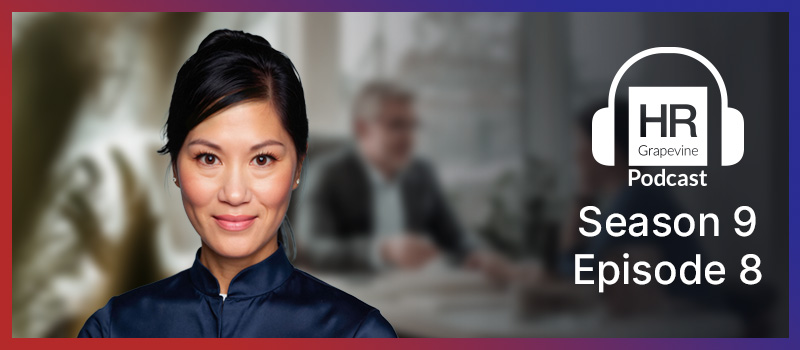
Angela Cheng-Cimini, Chief Human Resources Officer for The Chronicle of Philanthropy

What is organizational courage – and does your workplace have it?

Angela Cheng-Cimini, Chief Human Resources Officer for The Chronicle of Philanthropy, believes that the organizational courage, the “ability to confront the hard things,” is a muscle that nearly all employers currently fail to train.

She joins the HR Grapevine Podcast to break down organizational courage in-depth, how it can be built both structurally and culturally, and shares examples of what this may look like in practice.

Cheng-Cimini also outlines why organizational courage is more vital than ever, and how she has worked on building up her own courage as an HR leader across her extensive career.

Host: Hello, everyone, and welcome back to another episode of the HR Grapevine Podcast. I'm your host, Benjamin Broomfield, head of content here at HR Grapevine. And I'm joined today by Angela Cheng Cimini, chief human resources officer for the Chronicle of Philanthropy, the preeminent source for nonprofit professionals committed to the advancement of the common good. She previously served as the senior vice president of Talent and Chro for Harvard Business Publishing, home of the Harvard Business Review. And Angela brings thirty years of both generalist and specialist human resources experience, having worked across consumer product goods, professional services and high tech, as well as nonprofits. In addition to having served on the Alumni Board of directors for Cornell University, she's a member of NBC's Workforce Executive Council, a body of CHROs dedicated to advancing the practice of HR as a strategic board advisor for several early stage startups, supporting the future of work and serves as an advocate for the AAPI community for several nonprofits, and is also a member of the HR Grapevine Editorial Advisory Board. So a very warm welcome to you, Angela, and thank you for joining us on the podcast today.

Guest: Always a pleasure to be with you, Ben. Thank you.

Host: Wonderful. Well, today we're going to be discussing the topic of organizational courage. When we were arranging this episode, it felt like an area that you were really keen to talk about. So maybe to begin, we can begin with a definition or how you like to think about it. What is organizational courage?

Guest: It's the willingness to do and talk about the hard things. It was really born out of, frankly, what's, you know, watching what's been going on here socio politically in the United States. And to some degree, I think when we have elected officials, they show us who they are. So we should not be surprised when they carry out their agenda. But what has been disappointing are the enablers, the people who are willing to criticize and then change their tune once they realized where the power had shifted, and it's been a disappointment that they haven't been willing to stand up to confront the hard things. And that's often mirrored in organizations as well. People are intimidated, for whatever reason, by the CEO or their most senior executives, and unwilling to step up and talk about the elephant in the room. And so I think it's a subject of conversation, especially as a dimension of culture that requires more exploration.

Host: Absolutely. So would you say that this is the majority of business who are perhaps not doing enough to confront the hard things? Is this just perhaps a smaller group, but who obviously have a bit more influence because of the size of the organization or the popularity of their brand, whatever it might be? Do you think that there's sort of a bigger group of businesses there and but maybe also, what are some of the signs that I guess a business might not be exhibiting organizational courage?

Guest: Yeah. Unfortunately, I think this is prevalent across all organizations. I mean, it's the flip side of the coin of psychological safety, right? So you need to create an environment where people feel safe to say things. And you also have an obligation to step up and fill that space when the opportunity is presented to you. And so it happens at all levels of the organization. It doesn't just have to be intimidation by the CEO, but it could just simply be your direct manager. And so it's a muscle that new managers in particular need to build, how to create psychological safety and how to lead in such a way that people feel like they can screw up the courage to talk about things that are normally very difficult.

Host: Absolutely. Well, maybe across the rest of the episode, then we can look at what it really means to build that, that muscle and create that courage within your organization. Firstly, maybe it'd be useful to look at it from a structural perspective, and we'll come on maybe to a bit more of the cultural side in a moment, and presumably how that interlinks. But what are some of the structural things that organisations can do to, to make sure that that courage is there, whether that's within decision making or within relationships between different teams, different managers and their staff, what are some of the structural things that you think needs to be in place to, to build that level of organisational courage?

Guest: Yeah, you mentioned one right off the bat, which is cross functionalism or cross collaboration. To the extent that you and your team are not siloed. Right. Then you have much greater opportunity to be exposed to other perspectives, which then opens up the door to having conversations that are not just one way. And so when you work with others, that certainly helps to foster an environment of greater safety. Also, there should be mechanisms in place. There should be, you know, an HR help desk, a place where employees can go when they have issues or an ombudsman or a whistleblower hotline. Those are all systematic things that organizations can put into place, so that there are multiple venues for employees to raise issues when they're feeling like their direct manager isn't giving them the signal to do that.

Host: Definitely. And what about on the cultural side? I think this is an area where I'm really interested to go into a bit of detail, because you mentioned it's not just something from the leadership. This is all relationships within the organization. How can employers meaningful meaningfully build that culturally? What does what does that tend to look like? It sounds like it's not it's not an easy piece of work or a simple policy. It's something that's a lot more deeply embedded. So what are some of the steps that that employers need to take there?

Guest: So it is actually, I think, one of the hardest pieces of organizational muscle to build. And again, it very, very much like psychological safety. It requires the manager to have a sense of self-awareness, to be open to feedback. And if the leader is scary, they are probably least likely to want to hear the good, the bad, the ugly about their leadership skills. But that is, in fact how you know what it takes. And so if the manager themselves isn't capable of asking for feedback and checking in with their team to making sure that, have I left anything out? Have I given you an opportunity to speak up? What questions do you have then? It's the leader's leaders obligation to make sure that their managers and their teams are creating that sort of environment, but that's why it can be so insidious because it just it can easily breed to become a place where there is no psychological safety and where organizational courage can't bubble up. And what it requires is, you know, someone starting somewhere to start the ripple effect. And oftentimes that can be HR. I feel like that is our mantle, that if we're seeing pockets in the organization or if we are seeing wholesale, you know, cultural infection, then we have to stop and we have to step in and stop that. And oftentimes, I think HR themselves doesn't have the courage.

Host: I suppose when it does start with that one individual, obviously, I think that can be presumably fairly daunting. Understandably, it does take that that courage, but perhaps knowing where to get started and perhaps when you're dealing with, you know, leaders across different departments who maybe haven't had that strong a relationship with before. What are some of the good ways to, to get started and maybe broach what might be quite a difficult conversation at first? How does that tend to play out in your experience?

Guest: You don't need to go it alone. So building strategic allyship is really important. So finding people in your camp who may not necessarily support your position, but support you and are willing to pave the way to say, you know what I think? I think Benjamin has something really interesting to say, and he and I were talking about it. It makes it resonates for me. Benjamin, do you want to say more? So even playing that role as an ally or finding allies can be a really effective way to start to build organizational courage for yourself and for everybody within it.

Host: Definitely. I wanted to come back to the manager part of the conversation as well, because we talked so much about how important that relationship is. And I think in a lot of cases, you know, maybe managers just haven't had that training previously or haven't had that support or just haven't had that, you know, tangible experience of having to, to raise that voice or to create that opportunity for courage. So is that something you think that that businesses need to be, including in training programs for managers, that they need to be coaching that through mentorship? How can organizations ensure that managers have that muscle, have that strength, that.

Guest: Oh yeah. absolutely. Professional development for managers is paramount. And I'm not necessarily talking about a course or a workshop, but even on the job coaching, pulling them aside and saying, hey, this is something I observed during that meeting. Let's talk through that and, and sort of deep dive into the impact that I observed that your approach had. And really in the moment, capturing that while it's fresh in their minds and then doing that continuously so that they start to see the pattern so that they can break of it. It's hard to undo a habit when you don't know that you're committing it, right? I mean, it's sort of like posture. You don't necessarily see how you're slouching until someone says, like my mom says, you know, stand up straight, right. And so every time she does that, I remember that. Now I don't need her to remind me, I remind myself.

Host: Fantastic. It would be perhaps useful to hear a bit more, maybe of a couple of examples as well about the work that you've done, maybe to, to kind of develop and instill that organizational courage, maybe in the workplaces that you've been, you've been in. Are there any examples that spring to mind, either from the Chronicle of Philanthropy or previous employers as well, where you feel like you've been really able to, to deliver that that organization wide sense of courage.

Guest: Yeah. So this is early on in my career, which I think is interesting because I had relatively little influence, certainly no power, but I did have the strategic alliance of the head of human resources of our division at the time. And I was located at a manufacturing plant and we were undergoing a pretty significant change effort. We were actually trying to coalesce around teams, which is not something people on a manufacturing line necessarily think about, right? They're just sort of taking care of the one widget in front of them, not thinking about what came before, what comes after. And so we really wanted to change the mindset and get people to think across the entire line so that they could own the quality systems of the product. And it turned out, as I was talking to individual members of the leadership team, that they weren't completely bought in to what we were trying to do. And there was a clear trend emerging. And yet they were all afraid to confront the leadership team because the leadership team had made it so clear that this was the way forward and it was not negotiable. And so I wasn't really sure what to do. And so I rang up my head of HR, who was not involved in this effort. We were local, and he was sort of again, at the division level. And he gave me some really good counsel, which is you just got to have the conversation. He's like, I'm happy to be there with you, but you're the one who has to carry the water because you're the boots on the ground. You're actually watching this play out in in real time. And so I did. I called the director of manufacturing. I just did a one on one because he was the one I felt closest to. And, and he had the most authority. And he responded so beautifully. He had no idea and immediately called for the entire leadership team to come together. I again talked about what I observed and we changed our approach. We really opened up the floor. So the last time. So the next time we brought the entire team together, we put the agenda on hold. And we're actually to say we understand there's some concerns. Before we move any further in the roadmap, let's talk about what you think are the obstacles and broke it completely open. And from there the conversation was much more honest, much more candid. But again, it did require sort of that first mover principle to get the whole thing rolling. And with that, that we probably would have continued to bang our heads and wonder why the change management effort wasn't taking root.

Host: Absolutely. It's a really wonderful example. I wonder obviously the answer there was creating that really structured, safe forum for people to raise their voice and have that clear dialogue in terms of employers perhaps trying to, to get ahead of this almost before it becomes a problem and be a bit more proactive about it. Are there sort of specific ways that you think employers can create that open communication within the organization can create some of those forums for people to raise their voices? Is that something that employers can invest in now, rather than sort of after the fact, trying to undo perhaps some of the tension that's built up by not having those channels in the first place.

Guest: I mean, it's it is it is difficult, which is why it's called courage. I mean, to put the onus on employees without psychological safety is, as you said, very daunting. And it's not something that's terribly common. So in terms of what employees can do proactively, it's really try to build a good relationship with their manager. Testing, testing the manager's willingness to have hard conversations, starting with something that maybe isn't such high stakes and then moving into deeper issues that really require a difficult conversation, but also expressing to your manager that that's the kind of relationship you'd like to build with them, that that's how you're most productive, that's how you're most engaged, so that the manager starts to understand what it is you as the employee need to be high performing because what manager wouldn't want that?

Host: Definitely. It would be interesting to talk about the measurement side of it and perhaps how you can, you can look at that maybe to begin to assess whether or not there is a level of organizational courage in the organization or not, or if there are some of those problems there. You know, is it something that can be measured? Do you look at the level of trust in leadership or sort of approaches that way? How can you effectively determine if you're doing a good job of building organizational courage.

Guest: I mean, it's old school, you know, service. And it's ironic because the surveys work best when they're blinded, when they're anonymous, right. Which seems to fly in the face of stepping up forward and being courageous, but asking the question, how psychologically safe are you? Do you feel like your manager listens to you? How free do you feel to express your opinions? How open and welcoming are your colleagues of other perspectives? Those are things that you can absolutely test. And for leaders in particular, a three hundred and sixty degree feedback is a wonderful way to get a sense for how psychologically safe you're making the environment for your employees.

Host: Definitely. Maybe as a final question, you mentioned that experience really early on in your career, which I'm sure sort of helps encourage you to, to start building this muscle and develop that, that level of courage. And obviously having that relationship with, with the head of head of HR is almost that example of the on the job sort of mentorship that is really, really useful. But I wonder again, as sort of as a CRO. How do you continue to develop that muscle? From a personal skill set perspective? Is there any tips that you have for getting comfortable with that level of confrontation or conversation? Anything that you would recommend again, for, for our audience in terms of really going out and building their skill set to, to be able to develop this level of organizational courage.

Guest: So now that I've reached, you know, the level, I have found that it is actually more important for me to listen than to talk. And that might seem backwards because you think, okay, you're the head of the function, you should have all the answers. You should be worldly and wise and knowledgeable and share all of that expertise with your teams, when actually there is so much to be learned and so much to be gained if you simply sit back and listen. And when you do that, you open up a space for people to fill it with their own thoughts and perspectives. And so that is a really effective way to build psychological safety and to allow people to be courageous, is to share the floor with them and to ask them questions about. So what do you think if you were to poke holes in this, what do you see are the weaknesses in this approach or in my logic and asking the right questions, really inviting people in? And of course, those can't be performative. You have to be really sincere when you ask them for their feedback and act upon the ones that make a lot of sense. And if you're not going to do that, then explain why. Because nobody likes to be asked for their opinion, only for it to be immediately discarded. So I would say that one of the most important things that a leader can do to help build organizational courage and others is simply to listen.

Host: Well, I think that's a perfect piece of advice to wrap up the episode on. Angela, thank you so much for taking the time and taking us through this concept. A couple of personal examples in there as well, but lots of great advice, I think, for, for people to take away to their organization. And like you said, just a really important time to, to be doing that and developing that, that muscle and, and getting comfortable with, with listening and having those open conversations. So a huge thank you again for taking the time to join us on the HR Grapevine podcast.

Guest: Thank you so much

Be the first to comment.

Sign up for a FREE myGrapevine account to have your say.

Share this article:

You are currently previewing this article.Create account

This is the last preview available to you for the next 30 days.

To receive our daily newsletter and access HR features & insights, create a free account today.