Share this article:

'My Why' | Amazon's driver contest raises questions amid worker classification dispute

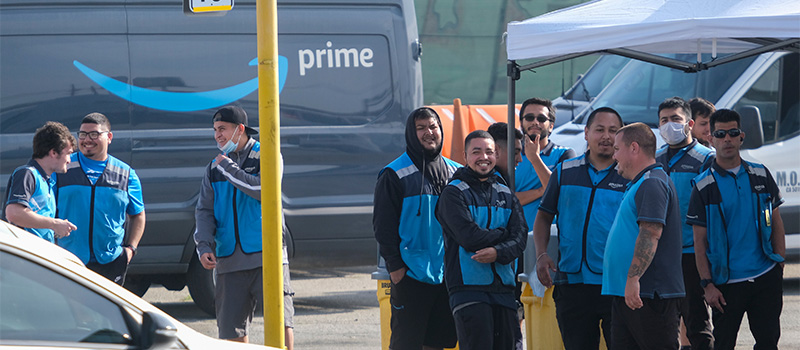
Amazon delivery team outside vans

Amazon’s latest attempt to engage its vast non-contract delivery workforce seems to have hit a few wrong notes head of an ongoing legal dispute around the rights of its ‘last mile’ delivery drivers.

The company is offering $1,000 prizes for delivery drivers who share stories about why they enjoy their roles, positioning the initiative as a way to celebrate the people behind its logistics machine.

But the mechanics of the contest, and the broader context in which it sits, point to a deeper tension between engagement strategies and employment structures.

Worker voice and consent in focus

Subcontracted drivers were invited to “tell us what drives you” as part of a “My Why” competition, with prompts encouraging them to reflect on “your journey to becoming a delivery driver, what you love about delivering smiles to customers, or how this role supports your bigger life goals.” The company also suggested describing “what makes you proud to wear the uniform each day.”

Employee storytelling campaigns are often used to strengthen culture, reinforce purpose, and amplify engagement. In this case, however, the audience is not a directly employed workforce but drivers working for delivery service partners, small businesses contracted by Amazon to manage hundreds of thousands of workers.

Drivers entering the contest must consent to having their words and image “used by Amazon in external and internal communications” and agree to take part in “any required media activity.”

While workers can withdraw consent, the requirement certainly raises questions about how “voluntary” participation in the initiative feels in practice, particularly in contractor-heavy ecosystems where workers rights are a little…fuzzy.

Amazon maintains that the initiative is part of a longer-standing recognition effort. But the astute-minded might suggest that it has one eye on the city of New York’s legal attempt to bring delivery drivers under its direct employ.

“For years, we’ve shown appreciation to DSPs and their drivers for all the great work they do to deliver to Amazon customers,” company spokesperson Steve Kelly said. “‘My Why’ is a nationwide contest meant to spotlight the drivers employed by our partners and celebrate the diverse motivations for doing this work and supporting their communities.”

One hundred participants will receive $1,000, while the top 10 will be offered a “VIP experience” for themselves and a guest. The winners will be selected by DSPs through an anonymized process, according to the company.

HR strategy meets legal pressure

The DSP model has faced sustained criticism over working conditions and the company’s stance that it is not the legal employer of drivers.

The New York City Council is set to consider legislation that would require companies like Amazon to directly employ last-mile delivery workers within city limits. At the same time, a US National Labor Relations Board judge is continuing to hear testimony in a case alleging that Amazon should be treated as the legal employer of certain contract drivers and therefore required to engage in collective bargaining. Amazon has denied wrongdoing.

Against that backdrop, the My Why campaign reads less as a standalone engagement initiative and more like part of a broader reputational strategy, even if the company rejects that interpretation.

“The winners of the ‘My Why’ contest will be decided by DSPs through an anonymized process and the idea that programming like ‘My Why’ is motivated by external factors is just false,” the company said.

Yet for some workers, the initiative lands differently. New York City delivery driver Jerome Sloss described the campaign as “a disrespectful effort to get drivers to help improve Amazon’s image,” adding: “They’re not even acknowledging us as actual employees, but they’re offering us $1,000 to talk about why we like ‘delivering smiles.’”

Engagement without employment?

The DSP model creates a layer of separation that complicates standard HR practices. While Amazon can influence culture, messaging, and recognition programs, it does not formally employ the drivers that deliver its packages.

That raises some uncomfortable questions about accountability, particularly when initiatives touch on sensitive areas such as personal storytelling and brand representation.

Rather than relying solely on surveys or internal feedback mechanisms to capture employee sentiment, companies are increasingly turning to narrative-driven approaches that double as external communications.

Incentivized storytelling can boost morale and visibility, but it also risks appearing transactional if not grounded in a clear and equitable employment relationship. And that, of course, is the crux of the matter when it comes to Amazon drivers.

Be the first to comment.

Sign up for a FREE myGrapevine account to have your say.

Share this article:

You are currently previewing this article.Create account

This is the last preview available to you for the next 30 days.

To receive our daily newsletter and access HR features & insights, create a free account today.